For those writers ready to publish, January is considered a peak month for the book market. Readers actively purchase new books to fulfill New Year's resolutions. For indie authors, January is crucial for establishing long-term writing consistency and momentum.
January for Urban and Rural Writers
January is the first calendar month and the best time to start a new concept—urban and rural fiction or nonfiction. Stories set in a cityscape are urban, while countryside tales are defined as rural. Here are some great resources to stimulate writing and publishing stories in January of this year.

January Infographic for Writers
We all wish for a country house tucked underneath fir boughs almost breaking with mounds of fluffy snow in January. In our minds and in our words, we can be in a rural countryside cottage for a single January.
For some, the city is the hearth and stone—without the urban landscape, DEATH! Forgo death this January and write stories about the urban scenes around you.
Here are some tidbits to help you find your way as an urban or rural writer this first month of the year.
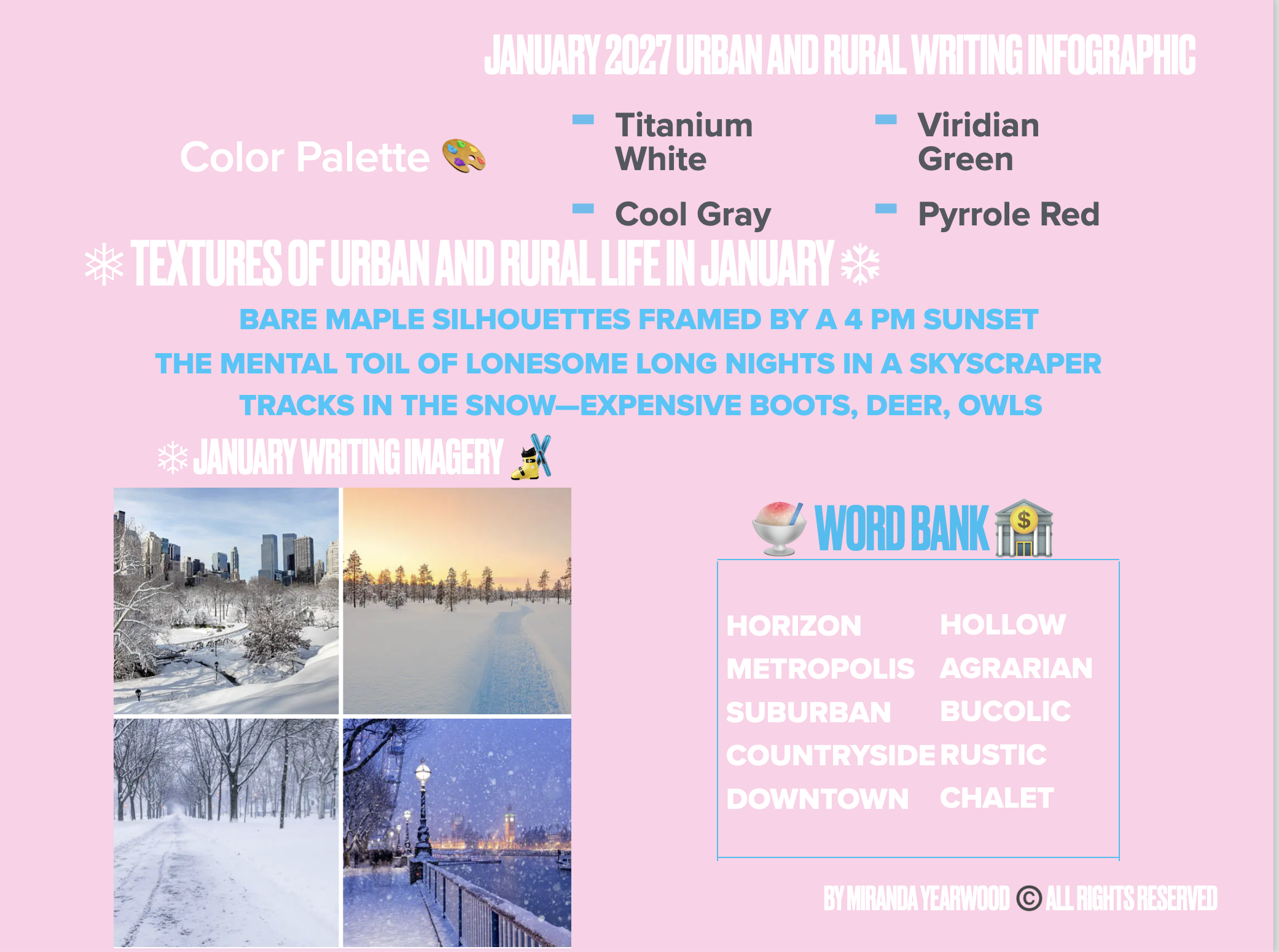
Sensory Tropes for January
Writing about urban and rural settings during the dead of winter can get icky fast. Instead of holiday tropes, avoid relying on overly nostalgic stereotypes.
Start with the stark and realistic aspects of the landscape. To help you, I have broken down these January concepts into three subcategories.
A Dead Winter Palette
January is not just snowy and white; it is a landscape seen in the golden brown of leftover corn husks. We view this first month on the calendar as a deep charcoal of frozen bark.
A dead winter palette is complete with the blistering bright yellow sunshine on fairy sparkling blue crystal ice.
Focusing on the colors of winter in January is an excellent way to bring the reader into the quietness of a rural scene.
Fierce Winter Winds
In the countryside, sharp winter winds are blocked by few trees or structures. Envision blizzard conditions of 60 mile per hour gusts of fresh, powdery snow. This will completely block a driver’s view as they can barely drive 15 mph.
Imagine the wind as a physical barrier or an unwelcome intruder attempting to infiltrate ancient structures. The wind becomes a character with a reason for blowing—whether this is through voodoo or natural circumstances.
You do not get high winds in the spring time or summer or even the autumn. Therefore, writing with a gusto of a winter breeze will make your January rural anything but boring.
The Sound of Isolation
January is the month of quiet reflection built upon our New Year’s resolution making traditions. As such, writing that reflects the sound of isolation is ideal for this month. We seek isolation as we strive for inner peace, especially after a blusteringly busy holiday season.
Consider the lurching hum of a low valley snow plow as the shovel pushes piles of dirty snow on a dark road. Listen for the sharp snap of freezing tree branches breaking under the weight of heavy ice and wet snow. All the while, the lengthy eerie silence at early nightfall creates a haunting atmosphere—even for January.
January Weekly Writing Prompts
Each month I will share a Weekly Writing Prompt calendar to help you stay on track with writing in that genre or concept.
Week 1: New Year’s Resolution Reality Show
New Year’s resolutions are goals that most adults set for themselves with good intentions this time of year. However, the joke has become that most adults give up their New Year’s resolutions within a couple of weeks.
Write a story about New Year’s resolution setting gone crazy. Maybe a character loses control of reality when they are unable to give up a bag habit—yes, a habit of buying new bags. A house might try to consume the household when they send everyone batty over their New Year’s resolutions. What is your spin on this idea?
Week 2: ER in an Urban Setting
Focus a story on an emergency situation in a big city setting. Consider a teenager flying along an unplowed snowy highway already late for curfew after a night on the town. What about an office suddenly taken over by a giant tree that has fallen in an ice storm?
Week 3: Step Out in the Countryside
Go outside on a snowy day and identify a single square foot of frozen ground. Write a descriptive piece discussing what you think is happening beneath the snow and ice.
Are there magical folk living in the hidden roots and sleeping seeds waiting for spring? Wonder about the realistic concepts of natural life, as well, in January.
Week 4: A Centurial Character in a Cold Spot
Write 100 words about spending time in an old homestead with a character who is from over 100 years ago. Bonus points if they endure a January freeze in some way, particularly if that freeze does not involve cold temperatures.
January Writer's Word Bank
As a final writer’s activity, elevate your seasonal prose with words that add interesting texture. Here is a list of words and definitions for your January writing toolbox.
Calcified—hardened into stone or ice; unyielding
Hearth-bound—the psychological state of being restricted to the radius of your heating source
Skeletal—describing orchard rows, tree lines, or old machinery covered in frost
Wind-scoured—stripped bare by the sheer force of open-air winter drafts
About The Urban Writers
The Urban Writers is a website that is affiliated with the writing software platform, Dibbly. Perhaps this is what prompted me to choose January as the month for Urban Writing.
By the way, as of May 2026, I am using the free version of Dibbly to explore how well the software is for short story and novel writing.
For The Urban Writers, January is historically the best and most critical month of the year for self-published authors using the platform and freelancers working within it.
The platform treats January as a foundational month due to specific e-commerce trends, seasonal promotions, and massive surges in project queues.
January is Best Month to Self-Publish
According to data and insights from The Urban Writers Blog, January is the absolute best month to release a book. Here is why:
Resolution demand—readers flood platforms on social media to pick up new hobbies and fulfill New Year’s resolutions, which is when it is best to advertise such book promotions
High buyer engagement—January sees elevated reader engagement and fresh financial spending on self-published titles compared to the end-of-year slump from September to December when buyers face budget fatigue
January Equals Work Boost for Writers
For ghostwriters, editors, and designers working on the platform, January marks a seasonal explosion in available jobs. Check out a few Dibbly-centric stats:
The January-ish influx—historical platform data shared by freelancers on Reddit threads shows that queues regularly skyrocket during this period (exploding from a baseline of ~10 pending orders to over 500 orders)
New Year, New Stories—the company heavily pushes marketing campaigns like “New Year, New Stories” to entice author entrepreneurs aka authorpreneurs to launch projects, translating to a massive wave of immediate work for platform freelancers
Seasonal Promo Codes and AI Integration
Also, if you are planning to order content or format a book through the Dibbly platform in early January, keep an eye out for their year-end and extended holiday sales. These include:
Holiday promos—the platform typically offers discount codes (such as HOLIDAY10 for 10% off) that remain active through the first week of January (ending January 6th)
Guided book flow—January launches often highlight their AI-assisted tools like Dibbly Create and KIP Scout, allowing publishers to build out outlines and map profitable niches swiftly before a human writer steps in…wink, wink!